If you’ve ever stepped into a warehouse aisle so tight you could reach across and touch both shelving units at once, you know how every inch of space matters. For anyone working in storage, retail distribution, or manufacturing with limited floor plans, narrow reach trucks aren’t just a piece of equipment—they’re the difference between cramming 100 pallets into your existing layout and needing to add an entire new wing to your facility. As a narrow reach trucks supplier, I get asked one question more than any other: “What’s the turning radius?” It sounds simple, but the answer isn’t a single number. It’s a detail that can make or break how smoothly your operation runs. Let’s break it down, from what turning radius actually means to why it matters for your business, and how to get the right fit for your space. Narrow Reach Trucks
First, let’s make sure we’re all on the same page about what turning radius really is. In basic terms, it’s the smallest amount of space a vehicle needs to make a full 180-degree turn without scraping walls, shelving, or other equipment. For full-size forklifts, that number is usually around 10 to 12 feet—enough space that a standard warehouse needs wide, 14-foot aisles just to accommodate those machines. Narrow reach trucks are designed specifically to cut that space down, which is why they’re such a game-changer. But here’s the thing: the turning radius isn’t just a random spec listed on a website. It’s calculated based on several factors, none of which work in a vacuum. The most important are the truck’s wheelbase, the length of its forks, and the way its steering system works.
Wheelbase is the distance between the front and rear axles of the truck. A shorter wheelbase means the truck can turn more tightly, right? That’s the core design of most narrow reach trucks. But if you shorten the wheelbase too much, you sacrifice stability when lifting heavy loads up high—something that’s non-negotiable when you’re storing pallets 30 feet in the air. There’s a balance every manufacturer has to strike, and that’s where our engineering team spends most of their time when developing our models. We don’t just aim for the smallest turning radius possible; we aim for a turning radius that lets you navigate your aisles safely while still lifting loads without tipping.
Another factor that often surprises new customers is the length of the forks. At first glance, forks seem like they’d only matter for how long a pallet the truck can carry, but they play a big role in turning too. When a reach truck is turning, the forks extend out in front, so their total length adds to the space needed for the turn. If you’re using 48-inch forks for standard pallets, that’s going to require a bit more space than 42-inch forks. That’s why when we talk to customers about their operations, we always ask them to share the length of their pallets and how high they need to lift. A customer storing small 36-inch pallets only needs short forks, which lets us tailor the turning radius perfectly to their aisle width, while a customer with 60-inch industrial pallets needs a slightly larger radius to accommodate those longer forks without swinging them into nearby shelves.
Now, let’s get to the numbers, because that’s what most people are here for. The turning radius for narrow reach trucks falls in a range that’s way smaller than full-size forklifts, but it varies depending on the type of truck and its capacity. The most common models, designed for standard pallet loads (up to 3,000 pounds) and aisle widths ranging from 6 to 8 feet, have a turning radius of between 5 and 7 feet. That’s half the space of a traditional forklift, which is why you can fit twice as many pallet positions in the same footprint. But if you’re looking at higher-capacity trucks—say, 4,000 to 5,000 pounds—or models built for very high lifts (over 30 feet), the turning radius goes up a bit, to around 7 to 8.5 feet. It’s a small trade-off, but worth it for the ability to move heavier loads without needing extra space.
Wait, though—there’s a difference between the turning radius listed in our spec sheet and the aisle width you actually need. That’s a point I can’t stress enough. A lot of new customers look at the turning radius number and think, “If my aisle is 7 feet wide, this truck will fit.” But the aisle width isn’t just the turning radius; you need to leave a little extra space for maneuvering, especially if your aisles have any obstructions like columns, door frames, or even other workers walking through. For our standard model with a 6-foot turning radius, the recommended aisle width is around 7.5 to 8 feet. That gives you enough room to turn without scraping the sides, even if you’re handling a load and can’t maneuver quite as precisely as an empty truck. If you have very narrow aisles that are only 6 feet wide, we have specialized compact narrow reach trucks with a turning radius of just 5 feet, designed specifically for those tight spaces. Those are the workhorses for retail distribution centers where every square foot is monetized—if you can add 20 extra pallet positions per aisle, that adds up to thousands of dollars in extra storage capacity every year.
I learned this lesson early on in my time as a narrow reach trucks supplier. A couple years back, a small e-commerce fulfillment center came to us, saying they had 6-foot aisles and were struggling with their old forklifts, which were knocking over shelving every other day. They were looking for a truck with a 5-foot turning radius, and we almost sold them our standard compact model. But when we visited their facility, we noticed their aisles had steel support columns every 10 feet. If we’d sold them that standard 5-radius truck, they would have had 6 inches of space on either side when turning, which would have been enough for a perfect operation. But they were also storing 50-inch pallets, and when the forks extended out, they’d only have 2 inches of clearance next to the columns. That’s a recipe for a collision that would cost them thousands in damaged goods and downtime. Instead, we recommended a slightly modified model with a 5.5-foot turning radius, which gave them 6 inches of clearance on both sides, and adjusted the fork length to match their pallets. They ended up doubling their storage capacity without widening a single aisle, and we’ve been their go-to supplier ever since. That’s the kind of hands-on work that makes being a narrow reach trucks supplier worth it—we don’t just sell a machine; we solve a specific problem for your space.
Another common question we get is about static vs. dynamic turning radius. The static radius is the minimum space the truck needs when it’s sitting still, turning on a spot, while the dynamic radius is the space it needs when it’s moving at a walking pace, which is what you’ll use 99% of the time in a warehouse. A lot of manufacturers only list the static radius, which can be misleading. At our company, we list both, because we know that when you’re navigating a busy aisle with other trucks and workers, you’re moving, not stopping and turning. Our dynamic turning radius is designed to be safe at the speeds you’ll actually use, so you don’t have to slow to a crawl just to make a turn. That’s a big difference from cheaper, no-name models that cut corners on steering systems to make the static radius smaller, but can’t handle dynamic movement without risking damage.
Now, let’s talk about how to measure your own turning radius needs. If you’re not sure what aisle width you have, or what kind of truck will fit, here’s a simple test you can do before even looking at specs. Grab a tape measure and mark out a space in your warehouse that’s the width of your narrowest aisle and the length of the truck you’re considering (including the forks). Have someone drive the truck in a small circle, and measure the total diameter of the circle it makes. That’s your actual dynamic turning radius, and it’ll tell you exactly if the truck will fit. But if you’re not comfortable doing that, or if you have unusual layout features like curved aisles or elevated cross-aisles, our team will come visit your facility for free. We’ll walk your aisles, measure your pallet sizes and lift heights, and help you pick the right model—no sales pitch, just honest advice.
It’s also worth noting that turning radius isn’t the only factor to consider, even if it’s the most visible. A narrow reach truck with a tiny turning radius is useless if it’s hard to operate, has high maintenance costs, or can’t handle the loads you need to move. That’s why all our models combine a compact turning radius with features like ergonomic controls, a wide operator cabin for long shifts, and a reinforced mast that keeps loads stable up to 35 feet. We also offer electric narrow reach trucks, which are better for indoor use because they produce zero emissions and are quieter, so they’re perfect for distribution centers with people working nearby. Our electric models have turning radii that match our diesel or gas models, so you don’t have to sacrifice space for sustainability.
Over the years, we’ve seen a lot of customers make the mistake of chasing the smallest turning radius possible without considering their actual operations. A customer with only 10 pallets to store might be fine with a tiny 5-radius truck, but a customer with 500 pallets needs a truck that’s easy to repair, has fast charging times, and can handle multiple loads a day. That’s why as a narrow reach trucks supplier, we don’t push one model for everyone. We ask questions: What’s your average load weight? How high do you lift? How often do you use the truck? How many aisles do you have? Those answers help us narrow down the turning radius and features that will work best for you, not just the smallest number on a spec sheet.
If you’re in the market for narrow reach trucks, the turning radius is a critical spec, but it’s just one part of the puzzle. The right truck will fit your aisles, handle your loads, and fit your budget, all while maximizing your storage space. Don’t take a spec sheet number at face value—get a supplier who will visit your facility, answer your questions, and help you pick a truck that’s built for your needs. We’ve helped hundreds of businesses, from small retail warehouses to large manufacturing plants, find the right narrow reach trucks, and we’re ready to help you too.
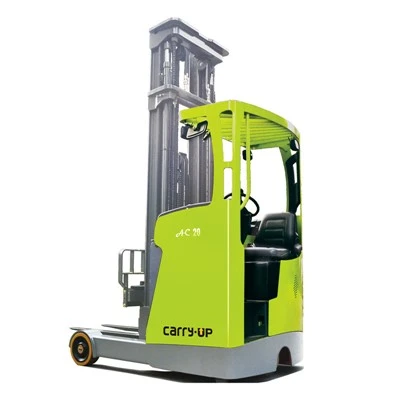
If you’re ready to talk about how a narrow reach truck can transform your storage space, connect with our team to discuss your requirements and arrange a demonstration.
Hand Pallet Trucks References
- Material Handling Industry Association. (2022). Narrow Aisle Equipment Spec Guide.
- Forklift Safety Council. (2021). Dynamic Turning Radius Best Practices for Warehouse Operations.
- Industrial Truck Manufacturers Association. (2023). Compact Reach Truck Design and Capacity Standards.
Hangzhou Carry Equipment Co., Ltd.
Hangzhou Carry Equipment Co., Ltd. is one of the most professional narrow reach trucks manufacturers and suppliers in China, also supports customized service. Please feel free to buy advanced narrow reach trucks for sale here and get quotation from our factory. For price consultation, contact us.
Address: No.360 Tongxiang Rd., Yinzhou Economic Development Zone, Yinzhou Dist., Ningbo, China
E-mail: Sales@carryupmhe.com
WebSite: https://www.carrymhe.com/
