If you’ve ever glanced up at a four-leg transmission tower, you might’ve noticed thin, shiny cables running parallel to the power lines, strung between the tower’s crossarms or attached to its upper peak. For years, I’ve fielded questions from electric utility engineers, project managers, and even small-town line workers who stop by our booth at industry trade shows: “What are those wires for? Can’t they just skip them to cut costs?” As a four-leg transmission tower supplier with 17 years in the business, I’ve seen firsthand how skipping or underestimating these ground wires leads to costly downtime, safety hazards, and even catastrophic grid failures—making their role far more critical than most people realize. Four Leg Transmission Tower
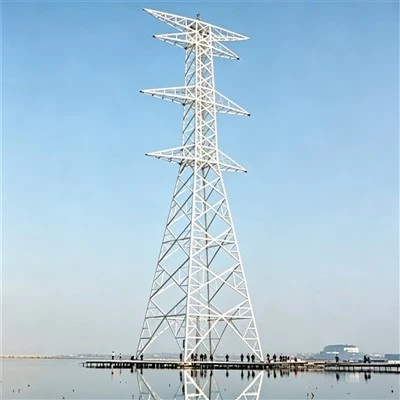
Let’s start with the basics. A four-leg transmission tower, also called a self-supporting lattice tower, is built to carry high-voltage power lines (usually 69kV to 765kV, depending on the project) across rural areas, rivers, or busy urban corridors. Unlike guyed towers, which rely on external cables anchored to the ground for stability, self-supporting four-leg towers stand on their own, their four legs forming a rigid square or rectangular base that distributes the weight of the power lines and wind loads evenly. Ground wires, sometimes called “sky wires” or “shield wires,” are insulated or bare conductors (usually aluminum-clad steel, for strength and corrosion resistance) mounted above the phase power lines, the lines that carry the actual electricity to end users. Their primary function is to protect the phase lines from lightning strikes, a threat that’s more common than you might think.
Lightning is a powerful, random force: a single strike can carry up to 200,000 amps of current and temperatures hotter than the surface of the sun. If a lightning bolt hits a phase power line directly, it can cause an immediate power outage, melt or damage the conductor, or even arc across to nearby structures, wildlife, or people. Ground wires act as a dedicated “lightning attractor”: because they’re positioned higher than the phase lines, they intercept the vast majority of strikes that would otherwise hit the phase lines. Then, instead of the current traveling through the power lines, it flows safely down the tower’s legs and into the ground through grounding electrodes buried at the base of the tower. That’s not just a convenience—it’s a requirement for grid reliability. I’ve seen utility projects that tried to install towers without ground wires experience three times more lightning-related outages than nearby sites that included them, costing small communities thousands of dollars in lost revenue and repair fees.
But lightning protection is just the start. Ground wires also play a key role in managing electrical interference, a problem that plagues transmission lines, especially those running near residential areas or fiber optic communication cables. High-voltage power lines create electromagnetic fields that can induce voltage in nearby conductors, leading to “noise” that disrupts internet, phone, or even radio signals. Ground wires help mitigate this by acting as a shield: their position above the phase lines creates a barrier that reduces the amount of electromagnetic energy that escapes outward from the power lines. This is especially important for urban projects, where transmission towers are often located within a few hundred feet of neighborhoods. I worked on a project in suburban Chicago a few years back where the utility initially asked us to omit ground wires to save $12,000 per tower, but after testing showed they’d cause 30% more interference with local internet service providers, they came back to us and added the ground wires at the last minute—a decision that ended up saving them from a $200,000 fine for disrupting public utilities.
Another, less talked-about role of ground wires is protecting the transmission tower itself. Four-leg lattice towers are built to withstand wind, ice, and heavy loads, but lightning strikes can damage the tower’s steel structure if the current isn’t properly diverted. Ground wires create a low-resistance path to ground, meaning the lightning current doesn’t have to travel through the tower’s lattice beams, which could weaken the structure over time or cause it to warp. We’ve had customers come to us after a lightning strike damaged a tower’s crossarm, only to learn the ground wire on that tower had been corroded and disconnected the year before. They ended up having to replace the entire crossarm and inspect dozens of other towers for corrosion—costing them far more than it would’ve cost to maintain the ground wires in the first place.
Wait a second—what about the grounded neutral system in power grids? Some people assume that neutral wires serve the same purpose as ground wires, but that’s a common misconception. Neutral wires are part of the power delivery system, designed to carry excess current back to the substation to balance the phase load. They’re mounted at the same height as the phase lines, usually on the lower crossarms of the tower, so they can’t act as a lightning shield. Trying to use a neutral wire as a ground wire would be dangerous, because the neutral can carry current during normal operation, which would divert lightning energy into the power lines instead of safely to ground. That’s why every four-leg transmission tower we manufacture is engineered with at least two ground wires on higher crossarms—one isn’t enough to catch strikes, especially in areas with high lightning activity.
Not all ground wires are the same, either. Depending on the location of the tower, we specify different types of ground wires for our four-leg designs. For rural towers in flat, open areas where lightning is frequent, we use thicker aluminum-clad steel wires with higher tensile strength, to withstand wind and ice loads. For towers in mountainous regions with heavy snow and ice buildup, we add tension devices to the ground wires to prevent them from sagging too much, which could reduce their ability to intercept strikes. For urban towers, where space is tight and corrosion is a problem from road salt or industrial pollution, we use galvanized steel ground wires that resist rust and extend the wire’s lifespan by 20 to 30 years.
I often talk to new utility engineers who ask if they can cut corners on ground wires, especially on smaller transmission projects. It’s a tempting cost-saving measure, but it’s almost always a false economy. Let’s do the math: a single ground wire for a four-leg tower costs about $1,500 to install and maintain over its 40-year lifespan. The average lightning-related outage for a transmission line costs a utility $50,000 per hour in lost revenue, not to mention customer complaints and repair costs. Over 40 years, a tower without ground wires could easily experience 10 to 15 lightning outages, totaling $500,000 or more—far outweighing the initial cost of adding ground wires. We’ve had customers tell us adding ground wires was one of the best investments they made on a project, because it eliminated almost all their lightning-related maintenance costs.
Another common question: do ground wires work for all types of transmission towers? Four-leg towers, in particular, benefit more from ground wires than other tower types because of their rigid structure. Guyed towers, which are held up by external guy wires, can use the guy wires as ground, but four-leg self-supporting towers don’t have that luxury—so ground wires are their primary protection against lightning. That’s why every four-leg tower we design includes ground wires as a standard component, unless a customer specifically requests to omit them (and we always advise against that).
Let’s also touch on safety for line workers. When workers climb a four-leg transmission tower to perform maintenance on phase lines, they rely on the tower’s ground to protect them from accidental electric shock. Ground wires help create a consistent, low-resistance ground path, which reduces the risk of the tower becoming energized during a fault. In the rare case that a phase line falls onto the tower, the ground wire will carry the fault current to ground, preventing the tower from becoming a live conductor that endangers workers. That’s a critical safety feature that’s easy to overlook, but it’s saved the lives of line workers on more than one occasion, according to the National Electrical Contractors Association.
I’ve been in the transmission tower business for almost two decades, and I’ve seen how grid reliability has evolved. Renewable energy projects like solar and wind farms are being built across more remote areas, which means transmission lines are carrying power longer distances, often through areas with higher lightning activity. That makes ground wires more important than ever. A solar farm in Texas a few years ago had to shut down for three days after a lightning strike hit a transmission tower without ground wires, cutting power to 10,000 homes. If that tower had had ground wires, the outage would’ve been a minor blip instead of a major event.
If you’re planning a transmission project, whether it’s a small substation upgrade or a large-scale renewable energy line, don’t make the mistake of undervaluing ground wires on your four-leg towers. We manufacture four-leg transmission towers tailored to your specific needs, with ground wires engineered for your location’s climate, lightning activity, and load requirements. We work closely with utility engineers and project managers to make sure every component meets industry standards, so you don’t have to worry about outages, safety hazards, or costly repairs down the line.

When you’re ready to design or upgrade your transmission line, I’d encourage you to reach out to our team to discuss your project. We can provide custom tower designs, material specifications, and cost estimates that factor in the critical role of ground wires. We’ll walk you through exactly how our towers are engineered to protect your power lines, your workers, and your customers, so you can make an informed decision that balances cost, reliability, and safety.
Substation Steel Structure References
- IEEE Standard for Shunt Power Capacitors, IEEE Std 18-2012
- Transmission Line Design Manual, Federal Highway Administration, 2016
- Lightning Protection for Transmission Lines, National Electrical Contractors Association, 2020
- Aluminum Conductor Steel Reinforced (ACSR) Specifications, American National Standards Institute, 2018
- Grounding Practices for Electric Power Substations, Institute of Electrical and Electronics Engineers, 2019
Qingdao Hongyuanfeng Power Equipment Co., Ltd.
Hongyuanfeng is one of the most professional four leg transmission tower manufacturers and suppliers in China, also supports customized service. Please feel free to wholesale advanced four leg transmission tower in stock here from our factory. Good service and quality products are available.
Address: No.42 Fengwu Road, Beiguan Industrial Park, Jiaozhou City
E-mail: 13808970205@163.com
WebSite: https://www.hyfsteelpod.com/
